
Blogue
La chirurgie a connu une révolution remarquable et silencieuse au cours des deux derniers siècles. Vous pouvez clairement constater ce changement profond en observant le contraste frappant entre les tables fixes en bois utilisées dans la chirurgie du XIXe siècle et les systèmes multi-positions hautement programmables utilisés aujourd'hui dans les établissements de santé modernes. La table d'opération n'est plus seulement un meuble. Il s’est transformé en une technologie essentielle à la mission qui sert de base à tout bloc opératoire.
L'évolution des tables d'opération reflète directement les progrès continus en matière de sécurité chirurgicale, d'amélioration des résultats pour les patients et d'efficacité accrue de la salle d'opération. Cet article explore le parcours transformateur de cet équipement essentiel de la salle d’opération. Nous examinerons attentivement les trois époques déterminantes de cette technologie : les conceptions mécaniques initiales, la percée de l’énergie hydraulique et l’ère moderne des systèmes électriques. En comprenant cette progression, les acheteurs des hôpitaux et des laboratoires peuvent prendre des décisions d'achat plus éclairées et choisir la table chirurgicale la mieux adaptée à leurs besoins spécifiques.
Pour vraiment apprécier les tables chirurgicales avancées d'aujourd'hui, nous devons d'abord examiner leur contexte historique. Une compréhension approfondie de l’histoire des tables chirurgicales aide les acheteurs à reconnaître l’immense valeur des innovations modernes.
Au début des années 1800, les tables d’opération présentaient des surfaces planes rudimentaires sans aucune capacité d’articulation. Les chirurgiens ont été confrontés à d’immenses défis car ces structures rigides n’offraient aucune flexibilité posturale. Ils ont été contraints d’adapter manuellement le positionnement des patients en utilisant des supports improvisés.
À mesure que la science médicale progressait vers la fin du XIXe et le début du XXe siècle, les fabricants d'équipements ont introduit des manivelles mécaniques de base. Ces premières tables chirurgicales mécaniques représentaient un pas en avant. Ils permettaient une inclinaison limitée du Trendelenburg et fournissaient des réglages de base de la section des jambes.
Cependant, ces tables d'opération manuelles souffraient d'une limitation opérationnelle critique. Les ajustements manuels ont obligé l'équipe chirurgicale à arrêter physiquement l'opération pour changer la position du patient. Le mécanisme de positionnement était intrinsèquement grossier et extrêmement difficile à régler avec précision. De plus, ces configurations manuelles n’étaient pas reproductibles dans différents cas, ce qui entravait les procédures chirurgicales standardisées.
Un signal de transition important est apparu à mesure que l’anesthésie et les techniques stériles progressaient rapidement. Les chirurgiens ont commencé à exiger un contrôle positionnel beaucoup plus fin et nettement plus rapide pour compléter leurs nouvelles capacités cliniques. Ce besoin clinique urgent a directement créé la demande pour la prochaine ère d’évolution des tables d’opération.
L’introduction de la table chirurgicale hydraulique a représenté un changement monumental dans l’équipement des salles d’opération. Ces systèmes offraient un mélange parfait de durabilité robuste et de mouvement raffiné.
Alors que les hôpitaux modernes et les centres chirurgicaux spécialisés cherchaient à optimiser leurs flux de travail complexes, la table d’opération électrique est devenue la référence. Cette technologie cible les installations bien équipées en offrant une précision inégalée.
Lorsque les gestionnaires d’installations envisagent d’acheter une table d’opération, ils doivent souvent peser les avantages d’une table d’opération hydraulique par rapport à une table d’opération électrique. Une comparaison équilibrée permet de clarifier cette décision vitale.
| Facteur d'approvisionnement | Table d'opération hydraulique | Table d'opération électrique |
|---|---|---|
| Infrastructure électrique | Préférable dans les régions où la fiabilité de l’alimentation électrique est manifestement faible. | Excelle dans les environnements modernes où une alimentation stable et des flux de travail numériques en salle d’opération sont la norme. |
| Mélange de spécialités chirurgicales | Souvent choisi par les hôpitaux généraux ou les cliniques spécialisées d'OB-GYN. | Favorisé par les grands centres multi-spécialités ayant de lourds besoins en orthopédie et en traumatologie. |
| Budget et coût total de possession | Présente un prix initial de table d’opération plus accessible et exige des coûts de maintenance continus inférieurs. | Offre des gains d’efficacité significatifs à long terme grâce à une rotation plus rapide des salles et des flux de travail automatisés. |
| Besoins réglementaires | Les acheteurs doivent prendre en compte les considérations CE, ISO et FDA pertinentes pour les différents marchés d'importation. | Les acheteurs doivent prendre en compte les considérations CE, ISO et FDA pertinentes pour les différents marchés d'importation. |
De nombreux acheteurs export expérimentés optent désormais activement pour une stratégie de flotte mixte. Ils placent stratégiquement des tables hydrauliques fiables dans leurs salles satellites tout en réservant des tables électriques très avancées pour leurs salles d'opération principales. Un fournisseur fiable doit systématiquement prendre en charge les deux options.
L’avenir des équipements de salle d’opération continue d’évoluer à un rythme rapide. Les acheteurs engagés dans l’exportation de matériel médical doivent rester conscients de plusieurs tendances émergentes.
Les tables d'opération ont considérablement évolué, passant d'instruments fixes et émoussés à des plates-formes chirurgicales de haute précision. En fin de compte, le choix du bon type de table chirurgicale détermine directement les résultats cliniques, l’efficacité du bloc opératoire et le coût global de l’établissement.
En tant que premier fournisseur de tables d'opération pour hôpitaux, Wincom de Chine fournit des tables d'opération hydrauliques et électriques de premier plan. Nous veillons à ce que chaque produit soit équipé d'une documentation CE et ISO complète spécialement conçue pour les acheteurs internationaux exigeants. Nous vous encourageons à vous associer à un fabricant de tables d'opération doté de capacités OEM/ODM approfondies, d'une vaste expérience en matière d'exportation et de régions d'expédition largement prises en charge afin de réduire les frictions pour les premiers acheteurs.
Pour une démonstration exceptionnelle de ces avancées mécaniques et électriques, nous vous recommandons fortement d'explorer l'exceptionnel Table d'opération OT-308B . Ce produit illustre l'ingénierie précise, les caractéristiques de sécurité robustes et la polyvalence fonctionnelle requises par les principales installations médicales d'aujourd'hui.
Veuillez demander un catalogue de produits ou obtenir un devis personnalisé dès aujourd’hui pour équiper votre bloc opératoire du plus haut niveau de soins.
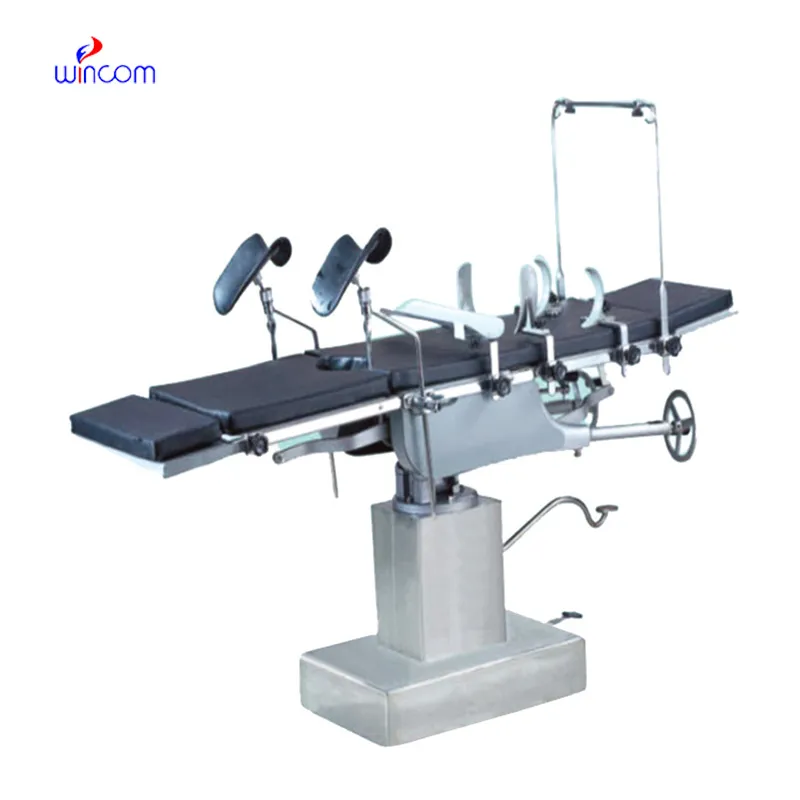
Les tables d'opération hydrauliques reposent sur la pression d'un fluide entraîné par des cylindres robustes pour ajuster le positionnement, ce qui les rend hautement indépendantes de l'électricité. Les tables d'opération électriques utilisent des systèmes motorisés contrôlés via des télécommandes et disposent souvent de fonctions de mémoire ; ils excellent dans les installations dotées d’une alimentation stable et de flux de travail numériques avancés.
Les tables manuelles nécessitent des ajustements via des manivelles mécaniques, ce qui obligeait historiquement l'équipe chirurgicale à interrompre la procédure en cours. Il leur manque le positionnement précis et rapidement reproductible requis pour prendre en charge les techniques stériles modernes et les protocoles d’anesthésie avancés.
Les conceptions radiotransparentes sont spécialement conçues pour une imagerie peropératoire sans entrave. Cette compatibilité essentielle avec l'arceau et l'équipement de fluoroscopie est essentielle pour exécuter avec succès des chirurgies orthopédiques et traumatologiques complexes.
Oui, ils restent incroyablement pertinents. Ils offrent une valeur immense grâce à leurs conceptions à base large et durables, leurs larges capacités de poids du patient et leurs circuits hydrauliques plus simples qui garantissent des coûts de service à long terme considérablement inférieurs. Ils sont particulièrement privilégiés sur les marchés d’exportation souffrant d’infrastructures électriques instables.
Les acheteurs tournés vers l’avenir devraient réfléchir à l’avenir des équipements de salle d’opération, qui incluent un positionnement assisté par IA qui réagit aux signes vitaux en temps réel. Recherchez également la compatibilité avec les systèmes de chirurgie robotique et les capacités IoT qui fournissent des diagnostics à distance et des alertes de maintenance prédictive.
E-mail: [email protected]
Tél : +86-731-84176622
+86-731-84136655
Adresse : Rm.1507, place Xinsancheng. No.58, Renmin Road (E), Changsha, Hunan, Chine


 EN
EN
 af
af
 es
es
 ar
ar
 tr
tr
 sw
sw
 pt
pt
 th
th
 ur
ur
 bn
bn
 ne
ne
 vi
vi
 km
km
 lo
lo
 de
de
 ru
ru
 fi
fi
 nl
nl
 fa
fa
 fr
fr
 ko
ko


